
100+ User-Generated Content Statistics for 2026
User-generated content (UGC) is now a key part of online buying. Reviews, customer photos, videos, ratings, questions, and social posts help people judge products and brands. In 2026, UGC also matters in AI search. This guide covers 100+ user-generated content statistics for 2026.
Thank you for reading this post, don't forget to subscribe!Public customer content can become part of the information people use when researching a business or product. It focuses on US consumer data where possible. Global research is included when it adds useful context.
Quick Answer: User-generated content can influence trust, research, and buying decisions. PowerReviews found that 99.9% of US consumers seek customer photos or videos before buying. It also found that 91% are more likely to buy when reviews include photos or videos. In 2026, BrightLocal found that 45% of US consumers use AI tools for local business recommendations.
Need content backed by real research? Work with Nusrat Jahan at iamnxahan@gmail.com.
Key UGC Statistics for 2026
Here are some of the most useful User-generated content statistics:
- 99.9% of US consumers seek customer photos or videos before buying at least sometimes.
- 91% are more likely to buy when reviews include photos or videos.
- 60% always seek visual content before buying.
- 48.5% always seek customer-submitted images.
- 70% consider customer videos necessary when researching products.
- 84% want customer photos and videos on product pages.
- 97% of US consumers read reviews for local businesses.
- 93% have purchased after reading reviews.
- 77% of Americans say online reviews are important to buying decisions.
- 45% of US consumers now use AI tools for local business recommendations.
- 88% of AI users check the sources or legitimacy of reviews cited by AI.
- 65% of global consumers say UGC is important.
- 75% of global consumers say UGC is useful for purchase decisions.
The data points to a simple trend:
People want evidence from other people.
UGC Statistics on Consumer Trust
Trust is one of the main reasons UGC works. A brand can describe its own product. A customer can show what happened after using it. Those two types of information are not the same.
PowerReviews found that 68% of US consumers value customer photos and videos because they feel more authentic and real than standard brand-created imagery. It also found that 89% use this content to see what a product looks like in real life.
Other findings include:
- 89% use customer photos and videos to see a product in real life.
- 72% use them to understand product size or sizing.
- 70% use them to understand product quality or performance.
- 68% value them because they feel more authentic.
- 56% use them to see if a product fits their needs.
- 46% say this content creates trust in a product or brand.
This explains why customer content can add something that polished brand photography cannot. A brand photo shows what the product looks like. A customer photo can show what it looks like in real life.
Visual User-Generated Content Statistics
Photos and videos are among the strongest forms of UGC. PowerReviews surveyed 15,870 US consumers in December 2023 for its visual UGC study. The research found that 60% always seek visual content before buying. Another 33% do so regularly.

The study also found:
- 68% of Gen Z always seek visual content.
- 63% of Millennials always seek visual content.
- 53% of Gen X always seek visual content.
- 44% of Boomers always seek visual content.
- 63% of men always seek visual content.
- 59% of women always seek visual content.
- 99.9% seek customer photos or videos at least sometimes.
- 48.5% always seek customer-submitted images.
- 38% regularly seek customer-submitted images.
The growth is notable. In 2021, 50% of consumers always sought visual content. By the 2024 study, that figure reached 60%.
Customer Photos Can Beat Polished Brand Images
78% of shoppers said a photo supplied by another customer was the most valuable photo type. By comparison:
- 17% preferred a professional brand or retailer photo.
- 5% preferred an influencer-supplied photo.
This does not make professional photography useless. It shows that customer photos answer a different question:
“What does this product look like in real life?”
UGC Video Statistics
Video gives shoppers more information than a still image. PowerReviews found that 70% of US consumers consider customer-generated videos necessary when researching a product before purchase.
The user-generated content statistics varies by generation:
- 81% of Gen Z
- 72% of Millennials
- 65% of Gen X
- 60% of Boomers
Customer videos can show:
- Product size
- Product movement
- Texture
- Fit
- Setup
- Sound
- Real-world use
- Product performance
For products that are hard to judge from photos, video UGC can answer important questions.
UGC and Purchase Decisions
UGC does more than create engagement. It can affect purchase decisions. PowerReviews found that 91% of consumers are more likely to buy a product when reviews include photos and videos as well as text. That was 85% in its 2021 benchmark.
The generational breakdown is also strong:
- 96% of Gen Z consumers are more likely to buy.
- 93% of Millennials are more likely to buy.
- 87% of Gen X are more likely to buy.
- 82% of Boomers are more likely to buy.
Another 61% said they were much more likely to buy when reviews included photos or videos. The reverse matters too. 23% of shoppers will not purchase a product when there are no customer photos or videos.
For Gen Z, that rises to 36%. So visual UGC can work in two ways. It can give shoppers more confidence. It can also reduce uncertainty that may stop a purchase.
Where Consumers Want to See UGC
Shoppers do not want to search hard for customer content. PowerReviews found that:
- 84% want customer photos and videos on product pages.
- 54% want them on product category or search pages.
- 51% want them on social media.
- 36% want them on the website homepage.
- 25% want them in promotional emails.
This gives ecommerce brands a clear lesson. Do not hide useful UGC on a separate testimonials page. Place it close to the buying decision. For most ecommerce brands, the product page is the key location.
Customer Review Statistics
Reviews are one of the most common forms of UGC. They remain highly important in the US.
BrightLocal’s 2026 Local Consumer Review Survey used a representative panel of 1,002 US adults. It found that 97% read reviews for local businesses. Consumers now use an average of six review sites.

ConsumerAffairs surveyed 2,000 Americans and found that 77% say online reviews are important when making purchasing decisions. About one in three said they will not buy without reading reviews first.
Other findings include:
- 93% of US consumers have purchased after reading reviews.
- 80% have avoided a purchase after reading reviews.
- 49% trust reviews as much as personal recommendations.
- 47% will not use a business with fewer than 20 reviews.
- 31% only consider businesses with 4.5 stars or higher.
- 74% care about reviews from the last three months.
The message is clear:
Review quantity matters, quality matters, freshness matters.
Review Recency Statistics
Old reviews can lose value. BrightLocal found that 74% of consumers care about reviews from the last three months. PowerReviews also found strong demand for recent reviews.
Its research found:
- 88% regularly consider review recency.
- 77% expect reviews to have been posted within three months.
- 80% say recency matters more for unfamiliar brands.
- 75% say recent reviews show that a product is still being used.
- 69% say recent reviews give a better view of current quality.
This creates a useful UGC strategy:
Build a steady stream of real customer feedback.
Do not rely on one review campaign every few years.
Review Volume Statistics
Review volume can also affect buyer confidence.
PowerReviews found that:
- 72% prefer 1,000 reviews over 100.
- 68% prefer 10,000 reviews over 100.
- 78% say review quantity matters more for unfamiliar products.
- 96% read more reviews when buying expensive products.
- 99% read reviews when buying a product they have never purchased before.
The lesson is not simply “get more reviews.”
The better lesson is:
Build a steady flow of authentic customer feedback.
More reviews do not replace useful reviews.
What Shoppers Want From Reviews
A star rating alone does not answer every question.
PowerReviews found that shoppers value:
- 57% – real-life product images.
- 65% – images showing products in use.
- 59% – longer, descriptive reviews.
- 57% – stories that match their intended use.
- 54% – clear pros and cons.
- 42% – information showing how the reviewer received the product.
- 36% – customer-created product videos.
This shows why detailed UGC can be more useful than a simple star rating.
A rating tells shoppers how someone felt. A detailed review can explain why.
Customer Q&A Statistics
Questions and answers are another form of UGC. They are often overlooked.
PowerReviews surveyed 15,870 US consumers for its Q&A research. The study found that 99% read Q&A at least sometimes when it is available. 74% read it always or regularly. Q&A can also affect conversion.
PowerReviews analyzed 1.5 million product pages across 1,200 brand and retail sites. Visitors who interacted with Q&A showed a 177.2% lift in conversion compared with visitors who did not interact with it.
That number is an observed lift from PowerReviews’ analysis. It should not be treated as proof that Q&A alone will increase conversion by 177.2% on every website.
Still, the finding shows why Q&A deserves attention. Customer questions can reveal information gaps. Those gaps can then become:
- Product-page answers
- FAQ content
- Blog topics
- Comparison content
- Video ideas
- Support documentation
UGC and AI Search Statistics
This is one of the biggest user-generated content statistics changes in 2026. Consumers are now using AI tools to discover businesses. BrightLocal found that 45% of US consumers use AI tools for local business recommendations, up from 6% in its 2025 data.
Other findings include:
- 31% use ChatGPT for business recommendations.
- 23% use Google AI Mode.
- 64% of adults aged 30-44 have asked AI for a business recommendation.
- 24% of consumers aged 60+ have done so.
- 63% of active AI users trust AI recommendations.
- 42% of consumers trust AI recommendations as much as reviews.
- 50% trust AI tools to accurately summarize online reviews.
- 71% of active AI users trust AI review summaries.
- 23% are willing to rely only on an AI review summary.
- 59% check review profiles for more information.
- 88% of AI users check whether AI-cited reviews are legitimate or check their sources.
- 97% sometimes double-check AI recommendations against real reviews.
This creates a new role for UGC. Customer content is not only something humans read. It can become part of the information ecosystem that AI systems use when answering questions.
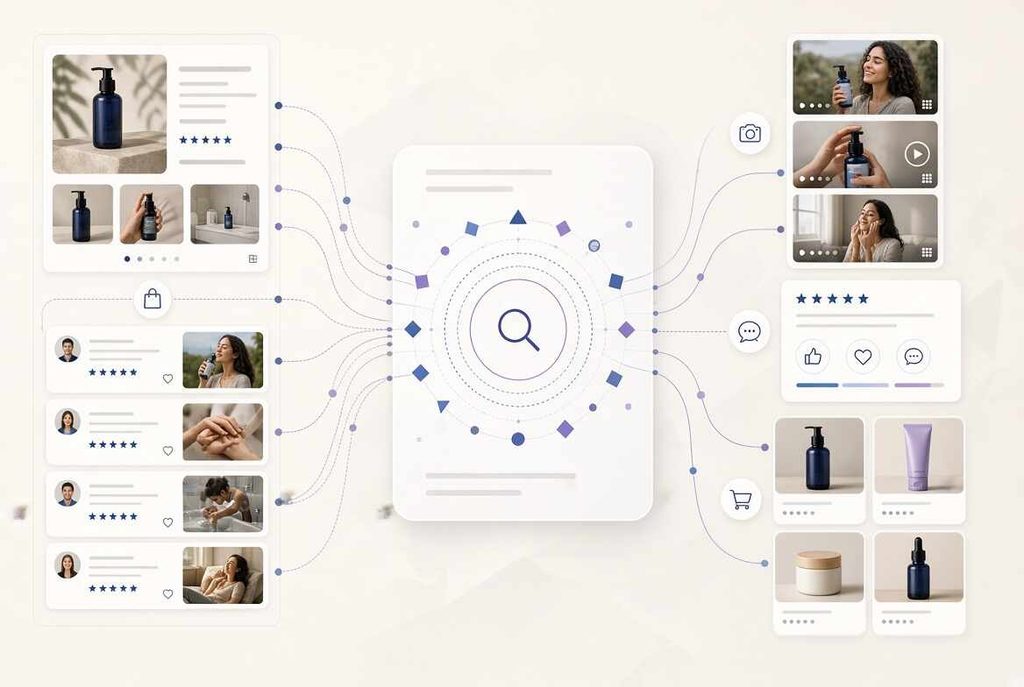
That does not mean a business can create reviews to “rank in ChatGPT.” It means brands should pay attention to the quality and consistency of their public reputation.
UGC and AI Citations
Search Engine Land published a 2026 analysis of about 35,000 ChatGPT citation URLs related to SaaS prompts.
In that specific dataset, UGC platforms accounted for 17.1% of cited domains, compared with 4.0% for publishers. That is a useful finding. But it needs context.
The study covered:
- US data
- ChatGPT
- SaaS-related prompts
- December 2025 citations
- About 35,000 citation URLs
So 17.1% is not a universal share for all AI search results. It shows that UGC can be a major third-party information source in a specific AI-search environment.
Search Engine Land also found that Wikipedia, Reddit, and LinkedIn made up 99% of UGC citations in that dataset.
The practical lesson is simple:
Do not think about AI visibility as a website-only problem.
Your brand’s public information exists across the web.
Reviews and AI Summaries
AI is also changing how people consume reviews. ConsumerAffairs surveyed 2,000 Americans in December 2025. It found that 87.7% had seen AI-generated review summaries. However, trust is not automatic.
Among people who had seen AI review summaries:
- 48.6% trusted them less than human reviews or did not trust them.
- 9.3% trusted AI summaries more than human reviews.
- Many consumers still prefer checking original reviews.
BrightLocal found a similar pattern. 59% of consumers check review profiles for more information after seeing an AI review summary. This matters because AI can summarize patterns. It can miss context.
A customer photo, specific complaint, date, or detailed experience may disappear inside a short summary. That is why original UGC still matters.
UGC and Local Business Discovery
Reviews can move people through the buying journey. BrightLocal found that after reading positive reviews:
- 66% do more research.
- 54% visit the business website.
- 34% are ready to buy or book.
- 37% read more reviews.
- 24% visit the business’s social media.
This shows that a review is not always the final step. It can start another search.
A consumer may read a review, visit the website, check social media, compare another business, and then book. User Generated Content Statistics can therefore support the full customer journey.
UGC and Business Responses
UGC is not only about collecting content. Brands also need to respond.
BrightLocal found that:
- 89% expect businesses to respond to reviews.
- 80% are likely to use businesses that respond to all reviews.
- 42% are unlikely to use a business that never responds.
- 50% may avoid businesses that use generic review responses.
- 19% expect a same-day response.
- 81% expect a response within a week.
This creates a useful rule:
Do not automate the human part of UGC.
A generic reply shows activity. A useful reply shows that someone listened.
Fake Review Statistics
UGC works because consumers expect it to be real. Fake reviews damage that trust.
BrightLocal found:
- 97% think businesses should face consequences for fake reviews.
- 63% want review platforms to detect and prevent fake reviews.
- 57% want businesses using fake reviews banned from review platforms.
- 46% want such businesses removed from Google search.
- 16% support criminal charges for businesses using fake reviews.
The lesson is simple:
Do not treat UGC as a volume game.
Real customer experiences are the asset.
UGC Statistics by Generation
UGC matters across age groups. The format, user-generated content statistics, and level of use can change.
Gen Z
Gen Z shows strong demand for visual UGC.
- 68% always seek visual content.
- 81% consider customer videos necessary.
- 96% are more likely to buy when reviews include photos or videos.
- 36% may avoid products without customer imagery.
Millennials
Millennials also rely heavily on visual UGC.
- 63% always seek visual content.
- 72% consider customer videos necessary.
- 93% are more likely to buy with visual review content.
Gen X
Gen X shows strong UGC use too.
- 53% always seek visual content.
- 65% consider customer videos necessary.
- 87% are more likely to buy with visual review content.
Boomers
Boomers use UGC too, although the numbers are lower in some categories.
- 44% always seek visual content.
- 60% consider customer videos necessary.
- 82% are more likely to buy with visual review content.
The important point is this:
UGC is not only a Gen Z strategy.
UGC Statistics by Product Category
Visual UGC can be useful across product types.
PowerReviews found that consumers consider UGC useful for:
- 88% – clothing
- 76% – shoes
- 74% – health and beauty
- 69% – electronics
- 64% – appliances
- 56% – home and garden
- 51% – computers
- 51% – toys
- 36% – groceries
- 35% – baby products
The best UGC format depends on the product.
- A clothing brand may need customer photos.
- An electronics company may need setup videos.
- A home brand may need before-and-after images.
- A SaaS company may need customer workflows and community discussions.
The best UGC answers the buyer’s real questions.
Organic UGC vs Creator Content
Not all user-created content is the same. This distinction matters.
Organic UGC
This usually includes:
- Customer reviews
- Customer photos
- Customer videos
- Product questions
- Customer comments
- Forum discussions
- Social posts from customers
The customer creates the content based on their own experience or interest.
Creator Content
Creator content may be:
- Paid
- Sponsored
- Commission-based
- Gifted
- Affiliate-driven
- Brand-directed
It can be valuable. But it should not automatically be treated as independent customer UGC. A sponsored creator video and an unpaid customer review can both help shoppers. The relationship with the brand is different.
UGC and SEO
UGC can add language that a brand may not use on its own. Imagine a shoe company targeting:
best shoes for wide feet
The product page might say: “Wide-fit design.” A customer might write: “I have wide feet and wore these for eight hours.” The second statement adds a real customer experience.
UGC can also surface:
- Long-tail phrases
- Product questions
- Use cases
- Problems
- Comparisons
- Objections
- Customer language
- Industry terms
This can make a page more useful. But there is an important warning:
More words do not automatically mean better SEO.
UGC should add useful information. It should not create a wall of low-value comments.
UGC for AEO and LLM Visibility
Answer engines and large language models need information to answer questions. Public customer discussions can provide useful context. A brand page may explain what a product does. Customer discussions may explain:
- What it feels like to use
- What problems it solves
- What problems remain
- Who likes it
- Who dislikes it
- How it compares with alternatives
That creates a wider information footprint. For AEO and LLM visibility, the goal should not be: “Create UGC, so AI mentions us.”
A better goal is: “Build a strong body of useful, authentic information about the brand and its products.” AI visibility can then become one possible outcome.
What These UGC Statistics Mean for Marketers
The data points to five practical actions.
1. Put UGC Near the Buying Decision
Show useful reviews, photos, videos, and Q&A on product pages. Do not hide all customer content on a separate testimonials page.
2. Ask for Specific Feedback
Instead of: “Please review our product.” Try: “How did the product fit?” Or: “What did you use it for?” Specific prompts can produce more useful answers.
3. Keep Reviews Fresh
Recent reviews help shoppers judge current product quality. Build a steady review process.
4. Turn Customer Questions Into Content Ideas
Repeated questions reveal content gaps. Use those questions to create:
- FAQs
- Blog posts
- Videos
- Product-page answers
- Comparison pages
5. Build a Wider Online Information Footprint
Consumers now use Google, review sites, social platforms, forums, and AI tools. Your brand reputation exists across those places. UGC is therefore part of a broader brand information footprint.
The Future of UGC in 2026
UGC is moving beyond social proof. It now supports several stages of the customer journey:
Discovery → Research → Comparison → Trust → Purchase → Post-purchase
- Reviews can support discovery.
- Photos can support product research.
- Videos can support comparison.
- Q&A can remove purchase doubts.
- Customer stories can build trust.
- Fresh reviews can help future buyers.
- AI tools can then summarize or surface some of this information.
That creates a wider model:
Customer experience → UGC → Search visibility → AI discovery → New customers
The process is not automatic. Brands still need real customers, useful products, honest feedback, and good customer service. But the role of UGC is becoming much larger.
Final UGC Statistics Takeaway
The strongest User-generated content statistics tell a simple story. Consumers want to know what real people think.
- They want photos that show products in real settings.
- They want videos that show real use.
- They want reviews with useful details.
- They want recent feedback.
- They also want answers to questions that brand copy may not cover.
In 2026, this behavior is expanding into AI search. 45% of US consumers now use AI tools for local business recommendations, while 88% of AI users check the legitimacy or source of reviews cited by AI.
That makes authentic customer content useful beyond traditional social media. For brands, the goal should not be to create the most UGC.
The goal should be to create useful customer evidence. That means real reviews, useful photos, helpful videos, honest answers, fresh feedback, and meaningful conversations.
When UGC answers real customer questions, it can help people make better decisions. It can also give search engines and AI systems more useful information to work with.
Sources and Methodology
This article uses research from PowerReviews, BrightLocal, ConsumerAffairs, Bazaarvoice, and Search Engine Land. US statistics are identified as US data when the source provides that context. Global statistics are not presented as US consumer findings.
Survey dates and sample sizes also vary. Statistics from different studies should therefore not be treated as one combined survey.
Key US datasets include PowerReviews’ survey of 15,870 US consumers, BrightLocal’s 2026 survey of 1,002 US adults, and ConsumerAffairs’ survey of 2,000 Americans.
Search Engine Land’s AI citation finding comes from a specific analysis of about 35,000 ChatGPT citation URLs for SaaS-related prompts.
Want content built for search and readers? Talk to Nusrat Jahan at iamnxahan@gmail.com.
FAQs
User-generated content is content made by customers or users about a brand. It includes reviews, photos, videos, posts, and questions.
UGC builds trust because shoppers can see real customer experiences. Reviews, photos, and videos help buyers judge products before purchase.
Yes, UGC can support SEO with fresh language, product details, and customer questions. It can also create useful pages and signals for search.
UGC can help AI search systems understand customer experiences and brand topics. Reviews, forums, photos, and posts add useful third-party context.
Product pages are a key place for UGC because shoppers want proof before buying. Customer photos, videos, reviews, and Q&A can answer doubts.
Yes, video UGC can show how a product looks, works, or fits in real life. Shoppers often value it because it feels more authentic than brand content.
Ask customers for honest reviews, photos, videos, or answers after a purchase. Make sharing easy and explain how their content helps other shoppers.
Yes, UGC can support local businesses through reviews, photos, and customer posts. Fresh feedback can help people research a business before visiting.
Conclusion
UGC helps people make informed buying decisions. Reviews, photos, videos, and Q&A add real customer experiences that brand content cannot always provide. User-generated content statistics show that shoppers value this content across products, services, and industries.
In 2026, UGC also matters beyond traditional search and social media. AI tools now help people discover businesses and products. Brands should focus on useful, honest, and fresh customer content that builds trust and answers real questions.
Ready to make your content more AI-search-friendly? Contact Nusrat Jahan at iamnxahan@gmail.com.